
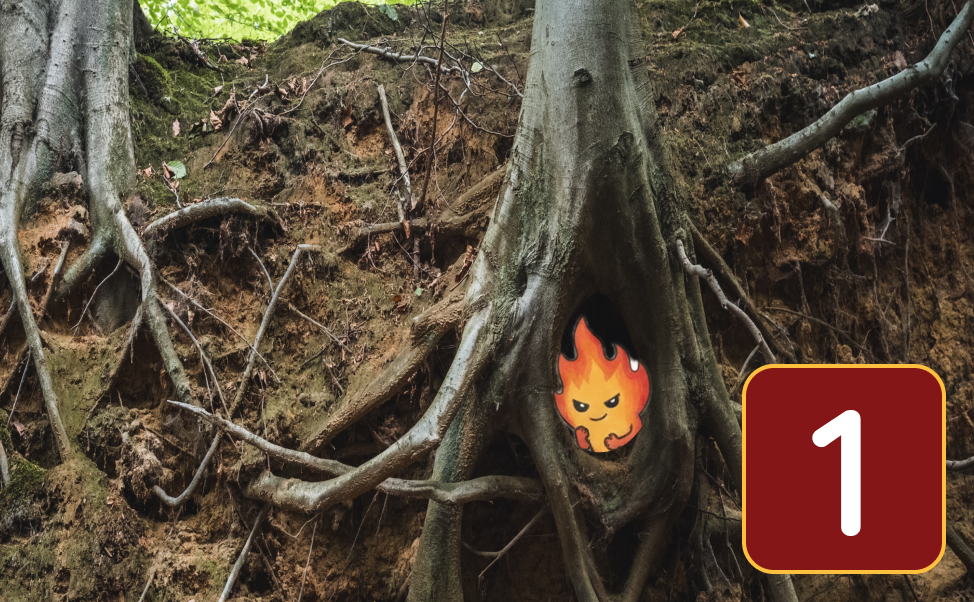
Ever think a wildfire is really out? You may need to think again: Meet the Zombie Fire! (Also known as a holdover, duff, root, or sleeper fire.)
The Zombie Fire isn’t the flaming inferno you see on the news. Instead, it’s a sneaky smouldering monster creeping underground, looking for a way to break free.
You see, the ground you walk on may not be as fireproof as you believe. Think about the last time you enjoyed the nice soft springy surface underfoot as you walked through the woods. That looked like a thin layer of damp moss and thick decaying leaves, right? But that might just have been the top of a deep layer of duff, organic matter tunneled through by everything from earthworms to tree roots to cute little bunny rabbits. This material is packed with carbon, stored there over thousands of years as plants die and decay.
It’s also the Zombie Fire’s favorite food. After fire fighters have killed the surface fire, the Zombie Fire may have burrowed into this organic soil layer, and transformed. In its new form it doesn’t need flames or wind to thrive. It smolders — a slow combustion reaction that happens with limited oxygen and at much lower temperatures — slowly turning that stored carbon into smoke and heat. A Zombie Fire can lurk for months, even years, surviving even under frozen ground. After eating along for miles, it can spring forth from its organic grave, giving birth to a new wildfire horror far from where it was first buried.
And that can be very bad: The 2025 Palisades fire was determined to result from a Zombie Fire!
Here’s the mind-blowing part: Per unit area, smoldering fire releases significantly more carbon into the atmosphere than flaming fire. A fast-moving, high-intensity surface fire burns the above-ground material quickly. But the slow, creeping smolder consumes the deep duff layer, releasing the centuries of stored carbon into the air. This makes Zombie Fires a feeder of climate change, not just a local hazard: The carbon released contributes to further warming, which in turn dries out the duff, preparing fuel for future Zombie Fires.
What can you do?
BEFORE the fire: Clear defensible space around your home, making sure to keep deep layers of flammable organic materials like mulch and leaves away from your foundation.
DURING (and after) the fire: Be cautious when walking on burned ground. Smoldering root systems and deep voids can lead to unstable soil and collapse, creating hidden traps disguised as solid ground.
AFTER the fire: Report any persistent, localized smoke or steam rising from the ground, as this could indicate a burrowing Zombie Fire that needs professional attention.
RIGHT NOW: Make a donation today to help Creative Crisis Leadership turn complex science into simple, life-saving knowledge!
Sources
- How This Fire Burns Underground (YouTube short) | Dr. Ben Miles
- Overwintering Fires, British Columbia Wildfire Service, June 2024
- How did the smouldering root fire on New Years Eve turn into the deadly 2025 LA fires? | CTIF
- Rein, Guillermo, and Xinyan Huang. “Smouldering wildfires in peatlands, forests and the arctic: Challenges and perspectives.” Current Opinion in Environmental Science & Health 24 (2021): 100296.
Stay Safe and Be Curious this Holiday Season!
0 Comments