
How do we spread a “yummy” destructive wildfire? We begin with good ingredients. Starting with the basic Fire Triangle of Fuel, Heat, and Oxygen, we then stir in appropriate Weather and favorable Topography to create a powerful wildfire.
Recipe for a Basic Fire
Ingredients
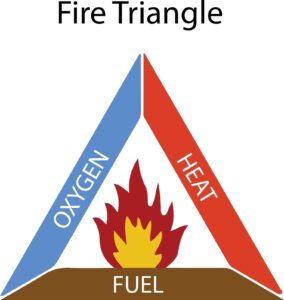
The fire triangle of Fuel, Heat, and Oxygen.
☐ Fuel: Anything that can burn: trees, dry grass, houses, or even the gases released from heating wood.
Note: Start with kindling or nice field of dried grass. Variations might include flammable mulch, dried-out wood of old porches and fences, or parched brush during a drought.
☐ Heat: A burning match, lightning, or a tossed cigarette, anything that provides the energy needed to ignite the fuel).
☐ Oxygen: The air we breathe—about 16% concentration is needed to sustain a flame.
Note: A slow-fire alternative is smouldering fires that need much less oxygen. See Curiosity #1: Just when you thought the fire was dead and buried …
Preparation
Combine all ingredients.
It is important to include all three ingredients of this Fire Triangle. Using firebreaks to remove fuel, dropping water on the fire to remove heat, or smothering the fire with heavy foam to remove oxygen can cause your fire to fail and die out.
Recipe for a Wildfire
Ingredients
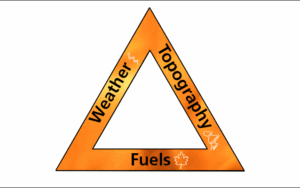
The Wildfire triangle of Fuels, Weather, and Topography.
☐ 1 serving Basic Fire, perhaps set in a remote wooded area. Be sure you have ample fuels to keep feeding the fire.
☐ Weather: Use dry, hot weather with a good strong wind to bring a fresh supply of oxygen to the fire, push the fire towards new fuel sources, and blow embers miles downwind to ensure a good spread.
☐ Topography: Start with favorable terrain, such as at the bottom of a steep slope. This way the fire can heat up the uphill fuels with rising hot air, and create spot fires with upward drafts.
Preparation
Step 1. Conduction: The Slow Creep
You can transfer heat through conduction — direct solid-to-solid contact – no need for actual flames to spread directly. For instance, you can ignite insulation or framing inside a house, by burning vegetation – trees, bushes, plants – within 5 feet of your house, what is called Zone Zero, and letting the process of conduction pass heat through the roof and exterior walls.
Step 2. Convection: The Skyward Surge
For a visually dramatic and powerful way of spreading your wildfire, use convection – a process in which the air directly above the fire heats up, becoming lighter and rising rapidly. This creates a massive column of hot gases and smoke, much like a super-powered chimney, lifting embers (also called “firebrands”) high up into the atmosphere to drop miles downwind, igniting new fires. This is the best way to have your wildfire jump highways, canyons, and massive firebreaks that get in the way of your beautiful fire’s terrifyingly unpredictable path.
Step 3. Radiation: The Invisible Roaster
To spread your wildfire quickly, you can use thermal radiation to “pre-cook” everything in a wide radius to prepare it for ignition. The intense radiant heat of a wildfire travels in invisible waves, pre-heating and drying out fuel before the flames even arrive. A great use of radiation is to turn green bushes into explosive tinder that your wildfire can just eat right up.
Step 4. Direct Flame Contact: The Classic Burn
Now you’re ready for the last and simplest step – spreading your wildfire through direct flame, when flames physically touch and ignite new fuel. By now, igniting fuel is easy, because you’ve used conduction and radiant heat to prepare your fuel, and skyward convection to spread embers far downwind.
What can you do?
If you don’t really want to feast on a good wildfire, you can keep your home safe for less destructive meals.
BEFORE the fire: Keep Zone Zero clear of flammables to prevent conduction from igniting fuel inside your home and direct flames from igniting fuel outside your home. Install fire-safe screening on all attic, foundation, and roof vents to block wind-borne embers (firebrands from convection) from entering your home and igniting.
DURING the fire: Be sure to close all windows and doors to prevent embers (and ash, and flame, and firefighting water and foam) from getting into your precious home.
AFTER the fire: Immediately check all sides of your house, roof and attic for smoldering debris after the fire has passed, as materials ignited by conduction can take time to show a visible flame, and embers, flown in via convection, can re-ignite as much as three days after landing.
RIGHT NOW: Make a donation to help Creative Crisis Leadership turn complex science into simple, life-saving knowledge!
Sources
- Wildland Fire Behavior (U.S. National Park Service)
- Protecting structures from wildfire embers and fire exposures
Stay Safe and Be Curious this Holiday Season!
0 Comments