
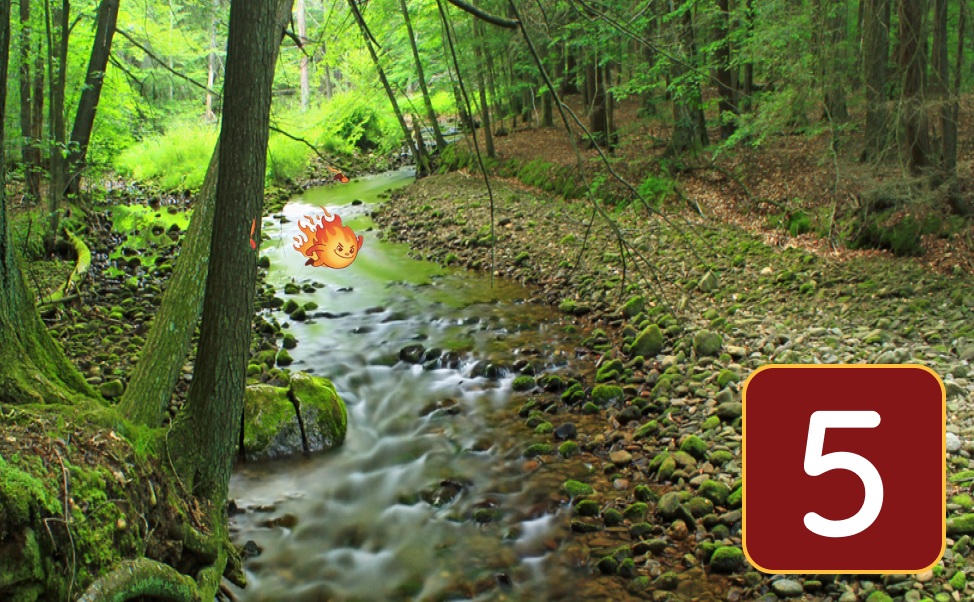
Loyalsock State Forest, Lycoming County. Broad, cobbled, and fed by many tributary streams, Grays Run meanders between steep slopes before emptying into Lycoming Creek. The wide floodplain along much of the stream eases access for fishing. By Nicholas A. Tonelli (swimming fire sprite added by CCL).
Mother Nature’s water cycle and your local water infrastructure collaborate in a long assembly line to deliver water right to your tap. But did you know that a wildfire can vandalize every step in this process? A wildfire can disrupt your water supply immediately – bye bye reservoir water – and set up for problems in the future – hello, floods!
Here’s the water supply assembly line and the wrenches that wildfire throws into the works.
Step 1: Clouds kick everything off by bringing rain.
However, wildfire smoke can clog clouds with zillions of microscopic water droplets that are lighter than traditional raindrops. These lighter water droplets prefer to float rather than fall, resulting in less rain.
Step 2: Soil absorption collects that precious rain water, storing some and passing some on to underground aquifers.
Along comes a wildfire, giving the soil a serious case of hydrophobia, hampering the soil’s ability to absorb water — it’s like the ground is wearing a giant raincoat! So, when it rains, the water can’t soak in. Instead, it runs off and is wasted in flash floods and debris flows.
Step 3: Trees, grasses and other vegetation shade the ground, keeping the water in the soil from evaporating.
But after a wildfire? Goodbye, vegetation! With no shade, the water evaporates, escaping into thin air instead of going into the water supply system.
Step 4: Lakes, aquifers, and reservoirs collect water from the soil over time.
Only, after a wildfire, the rainwater isn’t soaking into the soil! Instead, it rushes downstream, carrying ash and debris into the lakes and reservoirs, filling them with mud rather than water, decreasing their capacity.
Step 5: Water treatment systems filter out nasty contaminants from the water supply to ensure the water is safe to drink.
Of course, wildfires can attack treatment plants directly, and put them out of commission. More sneakily, though, wildfires can fill the incoming water with gunk from runoff, pollutants from burning cars and structures — even bits of melting pipes from the supply lines themselves. This can gum up the system for days, and even weeks!
Step 6: Finally, a giant network of underground pipes and water mains delivers the clean water to your tap, using electricity to move the water around, and make sure you can shower under comfortable water pressure.
Unfortunately, water delivery pipes — especially plastic — can only take so much heat before melting or breaking. Not ideal! Plus, wildfires often knock out the power grid.
So you see, the wildfire might last a week, but the impact on your water supply can haunt your community for a long time.
What can you do?
BEFORE the fire: Stock up on water. As a rule of thumb, you’ll need at least 1 gallon per person per day (plus what your goldfish and other pets need). If you’re on well-water, be sure your pump has a power source you can rely on if the electricity is out and everything is covered in ash.
DURING the fire: When a wildfire threatens your top priority should be getting away safely. If you’re ready to go, and you feel you have time, see how much water you have stored. Remember, that wildfire heat can easily melt plastic containers, so consider putting water in a cellar or other protected location.
AFTER the fire: If you evacuate, stock up on food and water before returning home. Check on your neighbors to make sure everyone has what they need.
RIGHT NOW: Make a donation to help Creative Crisis Leadership turn complex science into simple, life-saving knowledge!
Sources:
- How do Wildfires Affect the Water Cycle? | Western Fire Chiefs Association
- Wildfire Impacts on Drinking Water | EPA Small Drinking Water Systems Webinar Series, Jul 25, 2023
- Interdependencies Between Wildfire‐Induced Alterations | AGU
Stay Safe and Be Curious this Holiday Season!
0 Comments