

Seven Questions of Disaster Management — The Evolution of US Philosophy

On the seventh day of Thanks and Giving, we give to you … seven questions of disaster management, and trace the evolution of disaster management philosophy in the US.
In our last post, we described how Federal disaster relief is activated in the US. Today, we look at the evolution of disaster management in the US. We are particularly interested in how the Federal philosophy has changed in regards to seven basic questions:
- Who is responsible for managing disaster?
- Who has the legal and moral authority to make decisions?
- Who has the resources — assets, skills, knowledge, time — needed?
- What are the intended goals?
- What are the priorities?
- What is the scope of activities?
- What happens when efforts fail?
Current philosophy
Today, the prevailing philosophy in the US is that disaster management is the responsibility of local and state governments. The federal government supplements state and local efforts when their resources are insufficient. The goal is to be able to handle a full spectrum of disasters, rather than any specific threats, the “all-hazards approach.” The priorities are preparedness and response in order to
… save lives, protect property and the environment, stabilize the incident, and meet basic human needs following an incident … [and] enable recovery.
— National Response Framework
To meet these objectives, the government seeks to include all stakeholders — communities, businesses, nonprofits — in planning and delivering services, the “whole-community approach.”
How did we get here, and is this the right philosophy?
Let’s start at the beginning.
Disaster management is a community responsibility
For most of human history, disaster management is a community responsibility. When a mastodon injures half the hunters and wipes out the food supply, it is up to the villagers to help themselves and each other. With luck, they might get help from a neighboring village. And they might build a fence or post guards to prevent it from happening again.
Responsibility, goals, priorities, authority and resources all lie in the hands of the community itself.
1803: Federal support for recovery
Gradually, idiosyncratic systems of aid evolve. Local governments take on partial responsibility for helping their constituents in a disaster. Each develops their own philosophy of what and how much should be done.
On Dec. 26 1802, a fire blazes through the wooden buildings of downtown Portsmouth New Hampshire, and destroys 114 buildings, including 100 homes. In Jan 1803, the US Congress approves “A Bill, For the relief of the sufferers by fire, in the town of Portsmouth” that authorizes the suspension
… for months, the collection of bonds due to the United States by merchants of Portsmouth, in New Hampshire, who have suffered by the late conflagration of that town.
— H.R. 11, 7th Congress of the United States of America
This is the first act of disaster relief by the US federal government. Notably, the goal is economic recovery, and the “sufferers” who receive assistance are merchants. Portsmouth was an important seaport at the time, and pragmatically, congressional aims were to mitigate impacts on trade.
Over the next 150 years, Congress passes 128 separate laws offering disaster relief. Each of these is in response to a specific disaster, and require full congressional approval. In most cases, assistance is financial, frequently in the form of suspending financial obligations to speed economic recovery and prevent cascading consequences for regional and national commerce. There is no mention of humanitarian relief.
The ad hoc nature of Federal assistance in this period is exemplified by two catastrophic events, the 1889 Johnstown flood and the 1906 San Francisco earthquake:
On May 31 1889, the South Fork Dam on the Little Conemaugh River in Western Pennsylvania fails. Within an hour, flood waters destroy the towns of Mineral Point, East Conemaugh and Johnstown, kill an estimated 2209 people, and cause $17M of damage (1889 dollars). Contributions for disaster relief come from all over the country and the world, but, as far as we can determine, not from the Federal government. [Nathan Daniel Shappee. A history of Johnstown and the great flood of 1889: a study of disaster and rehabilitation. 1940.]
On April 18 1906, a rupture on the San Andreas fault West and North of San Francisco California triggers a magnitude 7.9 earthquake. Within days, more than 3000 people are dead and 80% of San Francisco is destroyed. Again, contributions for disaster relief come in from all over the country and the world. Congress enacts emergency appropriations for the city to pay for food, water, tents, blankets, and medical supplies. They also allocate funds to reconstruct damaged public buildings. [San Francisco Earthquake, 1906 | National Archives.]
In the first event, the federal government apparently does not act. In the second, the government acts to speed economic recovery — again, of an important center of commerce.
1881: American Red Cross and humanitarian assistance
While Federal funds are allocated to help pay for relief supplies after the San Francisco earthquake, the Federal government does not engage directly in the response. The US Army carries out relief activities, as they have in other disasters, e.g., after hurricanes ravaged Puerto Rico (1899) and Galveston Texas (1900). But such engagement occurs where the army is already present, and is authorized by local military officials.
On Sep. 4 1881, fires break out in Michigan’s “Thumb.” In two days, the Great Thumb Fire claims 282 lives, burns more than a million acres, leaves 14,448 people homeless, and causes more than $2.3M of damage (1881 dollars). The newly formed American Red Cross undertakes its first official disaster response, providing direct humanitarian assistance to survivors.
In 1900, Congress grants the Red Cross its first Federal charter. The charter includes a mandate for the Red Cross to,
… carry on a system of national and international relief in time of peace and to apply the same in mitigating the sufferings caused by pestilence, famine, fire, floods, and other great national calamities
— Our Federal Charter | Red Cross
This, effectively, designates humanitarian assistance a nongovernmental function.
1927: Federal participation in response
After months of heavy rain in April 1927, a series of 145 levee failures cause the Great Mississippi Flood. 246 people die, 27,000 square miles are inundated, and more than 162,000 homes in the Mississippi river valley flood. President Coolidge creates a commission to organize and oversee the government response, coordinating resources and relief efforts with the Red Cross. This marks the first time the Federal government participates directly in disaster response.
1936: Federal support for prevention
The Great Mississippi flood is only one of numerous floods that plague the country. Between 1849 and 1936, Congress funds a series of flood control acts to aid navigation. Disaster prevention is a secondary effect.
The 1936 Flood Control Act is the first general bill that provides for flood relief throughout the country, and is the first piece of legislation to recognize flood control as “a proper activity of the Federal Government.” It also “states a principle … that the federal government should take primary responsibility for dealing with the menace of terrifying, huge floods,” officially establishing a Federal role in disaster prevention. [Joseph L. Arnold. The evolution of the 1936 Flood Control Act. 1988.]
1950: Federal responsibilities spelled out
In 1950, Congress approves the Federal Disaster Relief Act, clarifying and formalizing the role of the Federal government in disaster management,
… it is the intent of Congress to provide an orderly and continuing means of assistance by the Federal Government to States and local governments in carrying out their responsibilities to alleviate suffering and damage resulting from major disasters, to repair essential public facilities in major disasters, and to foster the development of such State and local organizations and plans to cope with major disasters as may be necessary.
— P.L.81-875;64 Stat.1109
The bill establishes a general Disaster Relief Fund, and places funds directly under presidential authority. That is, congressional approval is no longer required to fund disaster relief. It explicitly states that the Federal assistance supplements state and local government efforts, and establishes the principle that the Federal government is not a first-line provider of assistance. It also puts a cost-sharing policy in place whereby Federal assistance is supplied when, and only when, State and local governments have committed “a reasonable amount of the funds” needed.
While the Disaster Relief Act gives the government responsibility for disaster management, it also sets clear limits on that responsibility. It prioritizes preparedness, response and recovery, but does not set policy or provide guidelines for delivering on government responsibilities.
Over the next thirty years, the country experiences a series of major disasters. Earthquakes: Hebgen Lake (Montana, 1959), Prince William Sound (Alaska, 1964); Cyclones and Hurricanes: Donna (Florida, 1960), Carla (Texas, 1961), Ash Wednesday Storm (mid-Atlantic states, 1962), Betsey (Florida, Louisiana, 1965), Camille (Alabama, Mississippi, Louisiana, 1969), Agnes (Eastern seaboard, 1972); Tornado outbreaks: (midwest, 1965), (midwest, northeast, 1974), to name a few.
Cold war politics add nuclear war to the country’s concerns. The Federal Civil Defense Administration develops civil defense programs across the country, encouraging individuals and communities to build bomb shelters. The Department of Commerce focuses on weather, warning, and fire protection, the General Services Administration on continuity of government and federal preparedness, the Department of Housing and Urban Development on flood insurance and disaster relief.
By 1974, more than 100 federal agencies are involved in some aspect of risk and disaster. The problems of a decentralized approach become apparent: States don’t know where to go when a disaster actually hits.
1979: FEMA established
On April 1 1979, Executive Order 12127—Federal Emergency Management Agency takes effect, putting the provisions of Reorganization Plan No. 3 of 1978 into place. This
- Establishes a new agency, the Federal Emergency Management Agency (FEMA),
- Transfers numerous emergency preparedness, mitigation, and response activities, along with associated resources, from other agencies to the new agency, and, significantly,
- Specifies that the Director of FEMA reports directly to the President.
However, the new agency experiences two challenges in developing a coherent philosophy for carrying out its mission. First, it is staffed with political appointees with little or no disaster management experience. Second, the next decade is relatively free of major disasters, and nuclear attack dominates national fears. Natural hazard programs receive little attention and suffer from attrition of funds and experienced personnel.
This proves disastrous when FEMA is slow and ineffective in responding to a series of catastrophic disasters, including Hurricanes Hugo (Puerto Rico, North Carolina, South Carolina, 1989), Andrew (Florida, Louisiana, 1992), Iniki (Hawaii, 1992), and the Loma Prieta earthquake (San Francisco Bay Area, 1989).
1993: Professionalization of disaster management
In the face of calls to disband the agency, newly elected President Clinton appoints James Lee Witt as Director. For the first time, FEMA is led by someone with emergency management experience. Things change quickly.
Agency priorities are expanded to include prevention and mitigation, and now cover all five phases of contemporary disaster management practice. An overarching goal is set to be able to handle any hazard. To achieve this comprehensive vision, the agency engages in a new community-based approach that aims to build partnerships with states and local authorities, and bring risk and risk avoidance considerations into communities’ everyday decision-making. For the first time, the business sector is included as a stakeholder.
By 2000, FEMA is recognized as the preeminent emergency management system in the world.
2001: Terrorism takes over
The 1995 Oklahoma City bombing brings concerns of terrorist attack to the fore. However, the knowledge, resources and technologies needed to deal with biochemical warfare and weapons of mass destruction are very different from what is needed for managing natural hazards. By 2000, authority and responsibility for addressing terrorist events is spread over several agencies.
In early 2001, the incoming Bush administration reorganizes FEMA. The new director lacks emergency management experience. Terrorism is considered the top concern, and ‘natural’ disaster management is deemed a state and local responsibility. Funding is cut for community-based initiatives.
On Sep. 11 2001, terrorists destroy the World Trade Center in New York and damage the Pentagon in Washington DC, killing 2977 people and causing $10B-$20B in property damage (2011 dollars).
A year later, on Nov. 25 2002, the Homeland Security Act of 2002 (HS Act; Public Law 107-296) establishes the Department of Homeland Security (DHS). The stated mission of the new department makes makes the goal of ‘natural’ disaster management a poor relation:
(A) prevent terrorist attacks within the United States;
(B) reduce the vulnerability of the United States to terrorism;
(C) minimize the damage, and assist in the recovery, from terrorist attacks that do occur within the United States;
(D) … [act] as a focal point regarding natural and manmade crises and emergency planning; [emphasis added]
[(E-F) ensure that other efforts and economic security are not diminished]
(G) monitor connections between illegal drug trafficking and terrorism, coordinate efforts to sever such connections, and otherwise contribute to efforts to interdict illegal drug trafficking.
— HS Act; Public Law 107-296, Sec. 101
FEMA loses its status as an independent agency, and no longer has direct access to the president. Its personnel and funds are redistributed within DHS, once again decentralizing authority and resources for disaster management. New levels of bureaucracy create confusion over who would be in charge in a disaster.
On Aug. 29 2005, Hurricane Katrina scours through Louisiana, killing more than 1800 people and causing $125B in damage (2005 dollars). Federal, state, and local government responses fall far short.
2006: Top-down emergency management
In the wake of widespread criticism, FEMA is reorganized. Again. While it remains part of DHS, the Post-Katrina Emergency Management Reform Act of 2006 (Public Law 109–295), brings all emergency functions back into the agency, protects its resources from reassignment, and gives the FEMA Administrator direct access to the President.
The new FEMA management adopts a top-down philosophy in which the Federal government is to take charge in a major disaster, supplanting state and local efforts.
This doctrine is short-lived.
2009: “Whole-community” approach
In 2009, newly elected President Obama selects Craig Fugate as FEMA Administrator. Fugate, a highly experienced emergency manager and former fire fighter, is an advocate for personal and community preparedness.
In 2011, FEMA releases a “A Whole Community Approach to Emergency Management: Principles, Themes, and Pathways for Action,” which lays down a local and state-driven all-hazards philosophy, and embraces a collaborative role of government,
Government can and will continue to serve disaster survivors. However, we fully recognize that a government-centric approach to disaster management will not be enough to meet the challenges posed by a catastrophic incident. That is why we must fully engage our entire societal capacity….
— Craig Fugate
Thirteen years later, this philosophy still prevails.
The UN Office of Disaster Risk Reduction (UNDRR), defines disaster management as,
The organization, planning and application of measures preparing for, responding to and recovering from disasters.
— Disaster management | UNDRR
Examining the evolution of disaster management philosophy reveals a changeable process that continuously raises seven key questions:
- Who is responsible for “preparing for, responding to and recovering from disaster”?
- Who has the legal and moral authority to determine what “preparing for, responding to and recovering from disaster” means?
- Who has the resources — assets, skills, knowledge, time — for “preparing for, responding to and recovering from disaster”?
- What are the goals of “preparing for, responding to and recovering from disaster”?
- What are the priorities in “preparing for, responding to and recovering from disaster”?
- What is the scope of “preparing for, responding to and recovering from disaster”?
- What happens when the “organization, planning and application of measures” fails?
We believe that a network of complementary philosophies is needed to meet the world’s disaster management needs. That is, that there are many “right” answers to these questions. We believe that increasing resilience requires developing community and government philosophies that complement each other rather than seeking to make them one.
Among other sources, this post draws on:
- Bullock, Jane, Haddow, George D., Coppola, Damon P. Introduction to Emergency Management. Butterworth-Heineman, 2020.
- Emergency Management Institute. A Citizen’s Guide to Disaster Assistance. Independent Study IS-7, (2003).
To celebrate the thanks of Thanksgiving and Giving Tuesday, today, we give a very special thanks to the many disaster management professionals who have fought to advance the philosophies of disaster management, including James Lee Witt, Craig Fugate, Barbara Cimino, Ken Dueker, Nancy Brown, Olga Crowe, Terry Unter, and Luke Beckman.
To help us promote a community-powered disaster management philosophy, please
support our work.
We thank you for all that you give.
Three CZU Fire Survivors Tell Their Stories

Photo by Landon Parenteau on Unsplash.
On the third day of Thanks and Giving, we give to you … three stories from people who had to flee their homes because of wildfire.
Cindy S. (not her real name) was at the grocery store when she received word that the Glass Fire had grown explosively and that she needed to get out immediately. She raced home, got her cat and two dogs into the car, and left. An hour later, the house was gone, along with all the family possessions.
We met Cindy at the 2022 Cloverdale Fire & Earthquake Safety Expo where she related her experience to us with pain in her eyes, tears in her voice, and gratitude in her heart that she, her family, her neighbors, and their pets had gotten out alive. We were there asking people to imagine what they would do if they had to evacuate at that moment. We also listened to many stories of real experiences, fortunately, few as dramatic as Cindy’s.
Learning from people who have experienced disaster is part of the research we do at Creative Crisis Leadership. We use what we learn to ensure that our immersive learning experiences are realistic, present participants with challenges that reflect real priorities, and create space for emotional realities.
Last year, we shared some insights on how wildfire affects everyone. Today, we share the stories of three people who were directly affected by the 2020 CZU Lightning Complex fires in California.
About the fire

CZU Lightning Complex fire perimeter.
On Sunday Aug 16 2020, lightning started numerous fires on the Western slopes of the Santa Cruz mountains. Early Wednesday, winds came up, and what became known as the CZU Lightning Complex exploded. By the time the fires were fully contained, a month later on Sep 22, they had burned 86,509 acres, destroyed 1490 structures, ravaged redwoods and historic buildings in Butano and Big Basin state parks, and caused one fatality.
Judy D., Judy S. and Barbara all live in the Santa Cruz mountains and had to evacuate. Here are their experiences in their own words.
Judy D.

Photo by John Pilge.

… we never thought we’d be experiencing fire, like, fire season was always, like, up north and east of here, right? You know, we live in a redwood forest. We live in a valley, six miles from the coast. So we thought that, you know, this isn’t going to happen here. And, over the last several years, like 2018, 2019, there’d be a small fire would pop up somewhere in the valley. It’s pretty heavily forested, but there’s also, 26,000, 30,000 people that live in these communities. And, as soon as a fire would pop up, Calfire was on it, or the local fire and volunteer fire departments were on it, and it would be out. So we never really thought that it would happen to us.
And of course, it started up a little bit further north of Big Basin and then, two days later, it was like, “Oh, no, there’s a fire.” We’re watching the fire, thinking, “They’ll get it out. They’ll get it out.” And as it kept creeping closer to us … we really didn’t think we were going to be evacuated. And then the next thing we knew is our friends in Boulder Creek are being evacuated. … we knew basically what we had to get ready. And we’re working with all of our neighbors. And all of our neighbors are talking.
My husband spent the time doing what we’ve learned from the fire departments and from all the videos about going around and hardening the outside of the home. Taking away the chairs, and we loaded up, … most of what was in the freezer we took with us. The power was still on when we evacuated. … and he took all of our little portable propane tanks, like for the grill and stuff like that, and put them out at the end of the driveway. I think we had four. And we had gas cans for a generator. So he put all the gas cans and propane cans out at the end of the driveway, which is what the fire department asked you to do. Turned off our propane tank.
It was a very orderly evacuation when they finally said, “It’s time to evacuate.” … we left when there was a warning. It was, it was terrifying. I mean, it was! … And you know, we’re thinking, “Ah, we’ll be gone a couple days.” [Laughs] “No, it’s not gonna be long.” And — my heart is just racing thinking about all this again — And we left, we backed out, and left. it was like, “Oh,” like, you back out of your driveway. And, you look at your house and say, “That’s probably it. Probably not gonna be here when I come back.” Because at that point, the fire was starting to come over the hill from Bonnie Doon. And so we just said goodbye and left.
We were very, very fortunate in that we had our in-laws to go to. You know, I have friends that were everywhere, from in their camper, and went down to Morro Bay. The hotels immediately all filled up in Santa Cruz, people could not find spaces to stay. And I think this is something that really needs to be done, is for people to kind of think through, where are they going to go if they’re evacuated? Because we’d never thought about it. And luckily we had relatives. But, you know, a couple friends got hotels, but I knew several people who were going from camp … campgrounds immediately filled up — you know, we’re in a place with a lot of campgrounds — they filled up with the motorhomes. But then all the ones up here were closed, the ones down in Santa Cruz on the beach were filled up immediately. So it took a day or two for people to find places to stay.
And then, as I said, we all thought it would be a couple days. And it was just being glued to the reports, glued to Calfire, glued to Twitter, and watching as the fire was moving in.
When we came back, we still didn’t have power for a week after we came back … The streets and the roads were lined with freezers and refrigerators that were just, you know, it’s like somebody died in there. It’s disgusting. It’s absolutely disgusting.
Judy S.

Photo by Susanne Jul
It was a real surprise that the fire came so close, because it moved fast. You know we had that thunder and lightning storm. And then three days later, two days later, we were evacuating, and it was raining ash.
I left before we got orders. Because, there was so much smoke and it was 85 degrees in the house. I couldn’t open the doors and windows. I don’t have air conditioning. So it didn’t make any sense to stay. And it looked like we were going to have to evacuate. So, you know, it made sense to go as soon as I could.
We’ve had to evacuate before. It actually was, “Okay, we’re going to evacuate. We’ll be gone for a few days and then we’ll be back.” But I didn’t come back for five weeks. I left on the 18th of August and I was allowed to come back on the fifth of September. And that was because of evacuation warnings and orders. They didn’t lift the evacuation order because there was still so many hot spots. They just didn’t want people around.
There was so much uncertainty during the evacuation. … There were three times during the fire that I thought [the house was gone], when we were evacuated. … this person has a camera on their house, and so he was watching the fire from the camera. And then the camera went out. And there was certainty — because the camera went out — that the fire had consumed his home and the creek, which meant it was going to come up the whole mountain here. That turned out not to be true. So, you know, there was good information, there was crappy information, you know. And a lot of that “Oh my god, my house is gone!” came from some of that. You know, should I be listening to this? What’s real? It’s just hard to know.
My neighborhood will never be the same. Because of it. And I, you know, we used to have a quiet, sweet little neighborhood and it’s not like that anymore. … there’s about 24 houses and seven of them burned in the fire. The fire was right across from my driveway road, it was on the other side of it.
I’ve gone through grief at the loss of my neighborhood and gratitude that my home is still here. … People are gone. My dearest neighbors don’t live here anymore. They live in Felton. People whose children I knew since they were born. And, just the character, the neighborhood changes, because some of the characters are gone.
So that’s what I’m noticing from people, is just the trauma. People, you know, people say, “Are you going to rebuild?” And one day it’s “Yes,” one day it’s “No,” one day it’s “Yes,” one day it’s “No.” And so it’s over a year later, and nobody has started to rebuild in my neighborhood.
Barbara
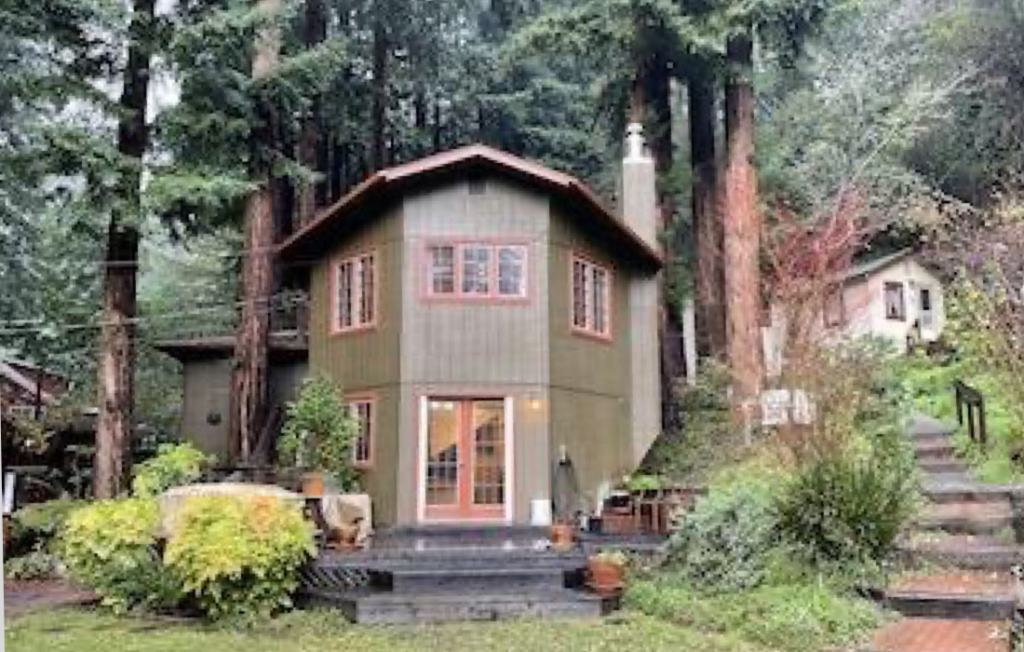
Barbara’s house
It was the day before, when I started hearing that there were fires getting closer. And I started thinking, “Okay, what do we actually really need?” Packing the car took us an hour, half hour, an hour, something like that. We might have, I think we packed up the night before, had the car ready to go. And then headed out, you know, midday the next day.
I realized, very quickly, that there was very little I cared enough about that I needed to take it. You know, I didn’t care about pictures, somebody else has the pictures. The only things I cared about were our paintings. Because every one was important to me. And so those were what we packed up. And then we grabbed a little bit of clothes. And that was about it.
I was expecting huge long lines of cars leaving the area? Nothing. It was just really smooth and easy. No traffic problems, no nothing. … I think it was really because people were leaving at different times. What is it? There’s 20-odd thousand people in the valley, three ways out. … We left before they actually placed the orders. And I think people were already leaving before that.
My son actually was concerned about us. And so, you know, we talked for a moment, I get a call an hour later, and he said, “Okay, I have booked you into this place on the beach, you can work there, you got the internet, you can do whatever you need to do.” And, so, we went there, … then I felt, “Oh my god, I can’t do this!” That was so dismal. I really did not want to have to stay in that [little hotel] for a couple of weeks. … We ended up going a little further down the coast of Monterey, to a place where my daughter was evacuated to. So we were next door to each other there. We then get a call from my brother saying, “Hey, my neighbor is just opening up his place. He’s got two rooms for you guys.” I’m ashamed to admit that it felt like a vacation that part, because my daughter had a big place, right? And we had a studio right next to it. My brother’s across the street, the rock in Morro Bay is across from us. And we hung out there for two weeks.
I had already come to terms with the idea that I might well lose my home of 38 years, you know? And, yeah, it was okay. I mean, I just thought about it, it is “Okay, a new start.” You know, and, but I also realized, “Ah, yeah! I’m okay with this, but I don’t want to! I don’t want to lose my home.”
It was the red sky that first day, when we came back. And it looked like a moonscape. It was the strangest thing. How, you know, the whole sky was red, it was orange. I’ve never seen anything like that. And, the smells, that burnt smell. And that strange, eerie, moonscape feel to all of it.
About a 1000 foot from our house. … as the crow flies. … When we got back, I was surprised how much burnt debris there was, you know, in the yard and, and everywhere. And the insurance company did send somebody out. And I’m saying, “I don’t think you need to come out. There’s no damage here.” And the guy went around with his white glove, or whatever he did. And said, “No, you got all this, this needs to be …,” whatever, handed us a bunch of money.
This has been how long ago? Oh, it’s exactly a year. Yeah. And then, goodness, about three months ago, we went, just walking with some friends up near our house, but from their property — they were much closer to it. And you saw all this new growth. So the whole forest was opened up, you know, so it was really light. And there were all these little things coming up. And it was, you really understood how this was a part of the cycle. And we’d stopped it for too long. And that’s why we’re seeing such a fierce reaction. But it truly is beautiful right now.
In terms of rebuilding, what people are going through is just a tremendous amount of time to get permits in our area. I don’t know of anybody who has started rebuilding yet. And that’s a year later, and they haven’t been able to get the permits to rebuild.
Read what Barbara had to say about home preparation in this 2021 Wildfire Advent post. For a moving reflection on what it meant to lose a house to the CZU fire, we highly recommend Dear Wild Child: You Carry Your Home Inside You by Wallace J. Nichols and Wallace Grayce Nichols.
To celebrate the thanks of Thanksgiving and Giving Tuesday, today, we give a very special thanks to the many individuals who have opened their hearts and shared their disaster stories with us: Your stories help to empower other communities!
To help spread the Judy, Judy and Barbara’s insights, please consider
supporting our work.
We thank you for all that you give.
Two Ways to Prepare to be Unprepared

Photo by Mick Haupt on Unsplash
On the second day of Thanks and Giving, we give to you … two surprising and critical ways to prepare for disaster!
What do you think of when we ask you to think about preparing for disaster?
Most people would talk about learning what to do and gathering supplies. Indeed, that is what most disaster management agencies focus on. They happily provide training classes and extensive checklists detailing what you should do and have. Many of these resources are well-designed and highly informative, for example, Calfire’s Prepare for Wildfire site and Red Cross’s What Do You Need In a Survival Kit.
However, is it really possible to be perfectly prepared? We think not. According to Juliette Kayyem, Faculty Director of the Homeland Security Project and Security and Global Health Project at Harvard’s Kennedy School of Government, there is no perfect preparation and no perfect response.
Why?
Researcher Stephan Gundel gives us some possible clues. He lays out a typology that classifies crises along two dimensions:
First, can we imagine a particular disaster? Do we believe it could happen? We can all imagine a car accident happening and believe that it could happen to us, so we wear seat belts. To pre-9/11 social consciousness, it was unimaginable and unbelievable that commercial planes filled with passengers would be used as bombs:
“The most important failure was one of imagination.”
Second, even if we can imagine a disaster, is there anything we can do to prevent it or reduce the damage it might cause? Do we have the resources and will to do so? For instance, we may not be able to prevent an earthquake, but we can take measures to improve earthquake safety. However, many such measures are very costly, e.g., retrofitting your house, or unrealistic, e.g., moving to another state.
“Even as climate change increases the frequency and intensity of extreme weather events, from fires to floods and hurricanes, two-thirds of Americans say if their home is hit they would rather rebuild than relocate …”
NPR, Most Americans would rather rebuild than move if natural disaster strikes, poll finds. 2021
Intersecting these two dimensions, predictability and influenceability, yields four types of disasters:

From Gundel, Stephan. “Towards a new typology of crises.” Journal of contingencies and crisis management 13, no. 3 (2005): 106-115.
Conventional disaster preparedness — learning what to do in particular circumstances and stockpiling resources — can only target conventional crises, the ones that are predictable and influenceable. For the rest we need something else.
So, It’s great to prepare, but it’s even greater to prepare to be unprepared.
But how can you prepare when you don’t know what you are preparing for? Here are two ways that we think are simple but critical.
- Get to know your neighbors
You may expect that your biggest source of help in a disaster will be disaster response agencies such as the local fire department, FEMA, Red Cross, or Civil Defense. Experience and research says that your biggest source of help will be the people you know and the people who are around you.
Researcher Daniel Aldrich who has studied the role of social networks in community resilience “has found that in a major shock, such as a tsunami or hurricane, a tightly connected community will save roughly 20 times more lives than the least connected community where nobody knows anybody (How to rebound from disasters? Resilience starts in the neighborhood | PreventionWeb).”
“Consider the earthquake that struck Japan on March 11, 2011. My colleague and I gathered data on and analyzed more than 130 coastal cities struck by the 60-foot tsunami. We found that communities with stronger social ties and more trust before the disaster had a smaller percentage of their population killed than similar communities that were less connected. While many engineers believed that the seawalls constructed along Japan’s Tohoku coast would save lives, we showed that social infrastructure, not physical infrastructure, kept communities intact. Survivors we interviewed told us that they’d only made it through because a friend or neighbor had helped them from their vulnerable residences.”
— Danel Aldrich, 2015, Some communities are destroyed by tragedy and disaster. Others spring back. Here’s what makes the difference. – The Washington Post
Other studies show that the people you know are instrumental in helping you get what you need in a disaster, including information, physical resources and practical help, as well as financial, emotional and psychological support (Elliott, Haney, & Sams-Abiodun, 2010; Hurlbert, Haines, & Beggs, 2000; Kaniasty & Norris, 1993).
So, get to know your neighbors!
- Develop your improvisation skills
If you’ve ever studied martial arts, you’ll recall that the first thing you learned was to fall. Not how to defend yourself or defeat your opponent, but learning to be flexible and adapt when you are thrown off balance.
The unpreparedness equivalent is to learn to think creatively about the people and resources around you. In other words, learn to improvise. Not only with things, but with the people who happen to be around you.
“[Improv] also highlights many of the soft skills that can be transferred to the work world, like being an engaged and active listener and being able to process information and react. If something comes up unexpectedly, these improvvers are ready to address it.”
— Harvard Business Gazette, For more than just laughs.
“Human beings are at their best when they are open to the world, able to notice what’s needed, and equipped with the skills to respond meaningfully in the moment. … This is what the great jazz players do: They learn by leaping in and taking action before they have a well-conceived plan. Once they’ve honed their skills, they know how to fabricate and invent novel responses without a scripted plan and no guarantee of outcomes. They discover the future as it unfolds.”
— Barrett, Frank J. Yes to the mess: Surprising leadership lessons from jazz. Harvard Business Press, 2012.
Being prepared for disaster is great. That includes making the plans, learning the skills and gathering the supplies suggested by disaster management agencies such as FEMA, Calfire, and Red Cross.
However, it’s greater to be ready for when the plans fail, the skills aren’t relevant, and the supplies aren’t there.
That’s why we at Creative Crisis Leadership do what we do: Create community workshops that provide communities with opportunities to experience some of the chaos and confusion of a crisis, practice improvising, and discover what they can accomplish with the people and resources that happen to be available.
On the second day of Thanks and Giving, we extend our special thanks to the communities who have helped to test our Wildfire Community Workshop:
- Windsor CA: Patti Restaino, Geoff Peters (COPE)
- Oakland CA: Shana & Noah Johnson, Ford Johnson, David Waxman, Brianna Taylor (Oakland OES), Kyle Tramblay (Oakland OES), Olga Crowe (Oakland OES)
- Portola Valley CA: Kristin & Rusty Day, Patti Fry
If you take disaster seriously, please
support our work.
We thank you for all that you give.
7 Tips visual challenge results!
We recently presented the amazingly creative Verbal to Visual community — led by the inspired and inspiring Doug Neill — with a challenge: Create a one-page sketchnote to make the “7 Tips for Being Effective in a Crisis” we identified in our research easy to remember.
(Sketchnoting combines doodles, sketches, and words to enhance learning, problem-solving and communication through visual thinking.)
Here is some of what these very talented people came up with. Feel free to print, frame and share!
Lai Chee Chiu

When Lai Chee Chiu was looking for an outing for her team, she found a workshop where you could ‘draw for work’ while having drinks and pizza, discovered sketchnoting, and reignited her love for drawing. Today she uses her skills to design workshops and bring them alive through visual storytelling and facilitation.
Her work is characterized by bold lines, strong characters, confident use of color, and playful humor. She is available to support your work, but beware, she only accepts projects “with the purpose to convey a message”!
Coralie Rozenblum

Coralie “Coco” Rozenblum is a sketchnoting novice, and is less confident in her skills than they deserve. She wants to use sketchnotes to capture notes and to facilitate conversations with clients in her coaching practice.
Her work is characterized by deep empathy, charming storytelling, and a simplicity and elegance of line.
Coach Jason

“Coach Jason” is a bit of an enigma in the community. We know he/she/they lives in Atlanta, works digitally, and always offers positive and constructive comments, but that’s about it.
What we can see is that his work is characterized by strong visual storylines and delightful humor.
Benoit Leclair

Benoit Leclair is relatively new to sketchnoting, but you wouldn’t know it from his work! Given that he has a degree in architecture, a career in steel construction management, and is a business analyst, it’s not surprising that he excels in bringing visual clarity to complex processes.
His work is characterized by lyric flows, rich information content, well-balanced layouts and exquisite details. Benoit is available to help you with your special projects.
2021: Not an Annual Report
Thanks to Social Good Fund, our fiscal sponsor, we don’t have to prepare a formal annual report. We do, however, have to report on our accomplishments and talk about our plans for the upcoming year. But we don’t have the trials of preparing financials and making it pretty. Yet.
Here is our 2021 activity report (with an “formal annual report”-type section added because we believe in gratitude). In retrospect, we are grappling with a mission that is neither obvious nor easy. I’m proud to say that we got a good grip on it in 2021.

2021 Activity Report
What did your project accomplish in 2021? What were your primary activities?
2021 was a year of developing a clearer understanding of the gap we are trying to fill, what it will take to fill it, and how we propose to do so. And of building toward an organization that has the necessary skills and knowledge.
To begin to fill the gap by sharing our knowledge, and to lay a foundation of skills, we
- Synthesized our COVID-19 findings into “Advice from the front lines,” 7 tips that successful spontaneous leaders would give to others who want to do something.
- Completed a promotional video, “Ready, Set, Earthquake!” that illustrates the live training approach that we bring to community disaster preparedness.
- Published a “Wildfire Advent Calendar,” sharing 24 pieces of information related to wildfire (one each day Dec 1-24) on our blog and LinkedIn.
- Initiated our social media presence by establishing a YouTube channel where we shared our promotional video, Roundtable recordings, and other products of our activities, and a LinkedIn page where we shared information about the materials we are making available.
In our endeavor to understand the gap and what it will take to fill it, we
- Completed the in-depth report of our study of spontaneous leaders in COVID-19.
- Convened two Research Roundtable discussions bringing together crisis response researchers with interests in citizen response and social networks, respectively.
- Started our Wildfire project by gathering background research on wildfire, interviewing individuals who had been through a wildfire, and gathering knowledge of the best practices and training as promoted by professional agencies.
To strengthen our operations, we
- Decided on a strategy for a coherent digital infrastructure (based on our systematic examination of available tools), and adopted Zoho Projects for project and task management.
- Held our first strategic planning meeting.
Describe the most pressing challenges and threats to your ability to advance your mission
Our most pressing challenges are a shortage of time, and failure to get the right people in the right places. To address them, we are working on making our value story more clear, improving volunteer recruiting and management, and instituting a targeted fundraising approach.
What are your plans for 2022?
We start 2022 with plans for advancing on 3 strategic goals:
- Grow our impact
- Mature the organization
- Expand our network
We plan on pursuing these goals in the context of developing a minimum viable product in the form of a Wildfire Learning Experience. We are currently designing the learning experience with the aim of conducting pilot events in May and June, followed by more general distribution starting late summer. In the course of developing community partnerships to support pilot events, we hope to attract the interest of potential board members, advisors, donors and funders, and to hone our storytelling.
How has fiscal sponsorship impacted your ability to achieve your mission?
Fiscal sponsorship has allowed us to concentrate our efforts on developing program vision and products, while giving us the credibility needed to be taken seriously, and enabling us to collect enough funds that we aren’t paying expenses out of our own pockets.
With Gratitude
If this were a formal annual report, it would include a mission statement, “success” statistics, and “accounting of major contributors.” In practice for the not-too-distant day when we will be preparing a formal annual report, I’d like to add the last section.
My personal thanks to everyone who has helped Creative Crisis Leadership move closer to making the world more socially resilient in 2021:
The core team:
- Garett Dworman: My eternal thanks for your unstinting enthusiasm, and for continually refreshing my belief in the importance of what we are doing.
- Zach Pipkin: For your stabilizing influence, loyalty, and always keeping us grounded.
Our first official advisor:
- Leland Franklin: For your insight, shining example, and quiet guidance.
Our other invaluable volunteers.
And, our major and staunch donors.
- Maurita Holland
- Kat Chadwick
- George Furnas
- Kyle Brown
Without your encouragement and support, it would be all too easy to lose sight of the light.
— Susanne Jul, PhD
Founder & Driving Force, Creative Crisis Leadership
Learning from COVID-19 grassroots leaders: 7 Tips to be Effective in a Crisis (part 3 of 2)

At the outset of the COVID-19 pandemic, we set out to learn from Spontaneous Leaders — people who had started a grassroots response to help their community. We gained a clear understanding of what support they need (Learning from grassroots leaders in COVID-19, Part 1), and about what services we might offer to help them (Learning from grassroots leaders in COVID-19, Part 2). We also identified seven behaviors that they consistently identified as being critical to their success.
Here is their collective advice.
7 Tips for Being Effective in a Crisis
- Just start
Take a step. Take another. Keep going. Don’t let not knowing hold you back. - Don’t be afraid to fail
If you do something, you may succeed. If you do nothing, you’ve already failed. - Don’t go it alone
Get others to help. Collaboration will make it easier, and help you do more. - Build on what you have
Use the skills, resources, and relationships that are available to you. Develop new ones as you go along. - Focus
Tackle one problem at a time. Don’t try to do everything at once. - Iterate
Get it out there. Get feedback. Adapt. Don’t polish it too much. - Don’t be afraid to lead
Leadership is about helping the group to succeed. You don’t have to be a boss to lead.
2021 Wildfire Advent Calendar complete!

If you didn’t have a chance to follow our very successful 2021 Wildfire Advent Calendar, here is the full list:
- How do wildfires get their names?
Learn how wildfires are named in California. - Fire tornadoes
See the drama of how large fires create their own weather events. - Wildfire, it affects EVERYONE
Understand the staggering impact of wildfires. - Don’t inhale!
Even an N95 mask isn’t adequate protection from wildfire smoke. - “My God, it’s so simple!”
The basics of “hardening” your house against wildfire. - Change the odds, save your house
Discover the two main steps to protecting your urban house against wildfire. - Don’t drone near a wildfire
Find out how unauthorized drones near a wildfire threaten lives. - How do you fight a wildfire?
Learn the basic strategy of wildfire fighting. - Do not hesitate, evacuate early!
There are many benefits to leaving early. - Who causes more wildfires? Humans vs Nature!
The data for Smokey the Bear’s admonition are pretty compelling. - Community programs: Firewise and CERT
Two national programs that you can work with in your own community. - The 5 phases of disaster management
The framework professionals use to organize their thoughts and actions. - How are wildfires measured?
Understand how do scientists and professional talk about the size of a fire. - Can Mary get arrested?
Learn what different evacuation orders really mean. - It ain’t over till it’s over
The effects of a wildfire can linger long after the flames are out. - 17,325 gardens and a scrapie thingie
Fighting a wildfire takes a lot of people and a lot of hard physical work. - Embers happen!
Understand what your concerns should be when there’s a wildfire in your area. - Prescription Rx for our forests?
Prescribed burns are both an old and a new approach to forest management. - Wildfires run faster
See the data for your chances of outrunning a wildfire. - Getting Ready to Evacuate
Get clear on what your priorities should be when you might have to evacuate because of a wildfire. - When in doubt, throw it out!
Learn some things about evacuating that you might not have thought about. - Your greatest asset
The people around you are likely to be the most important to you in getting through a wildfire. - Please help us to set some fires!
We need your support to develop a new approach to helping communities to prepare for wildfire. - Wildfire tribute
A salute to all the people who help get us through wildfires.
Please help us to set some fires!

Photo by Scott Anderson
The 2021 Wildfire Advent Calendar has been brought to you by Creative Crisis Leadership, a fledgling nonprofit organization with an award-winning new approach to community disaster preparation and a mission to prepare people to be unprepared.
Now it’s your turn.
We need your support to set fire to five communities before May 31, 2021.
OK, not literally. Although, we want them to feel and think like a wildfire really is threatening their homes.
You see, we believe that the best way to learn something is to practice. So we create fun and engaging immersive learning experiences that throw a small group of strangers and neighbors into an (imagined) disaster. They get to discover what they need, and are capable of, before they are faced with the real thing.
Watch this video to see how our approach works.
With your help, we can pilot our new wildfire learning experience in five communities in Northern California. Once we know it produces the right learning outcomes, we’ll work with different community-based organizations so that they can set (imagined) fires under many more communities.
Please donate now to help us to set our first five fires!
Leland Franklin: First official CCL advisor!
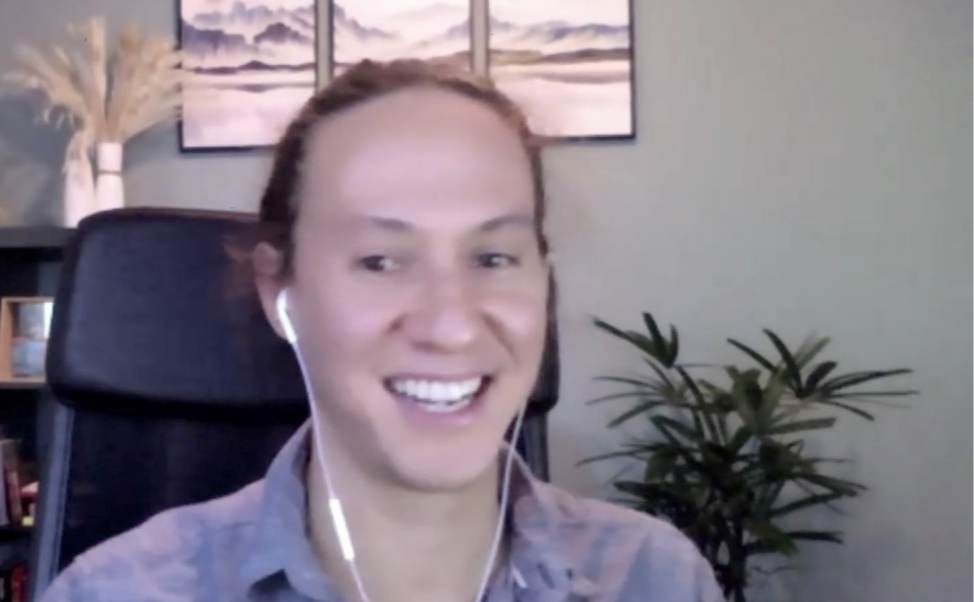
I am delighted to announce that Leland Franklin has agreed to become an official CCL Advisor!
We first met Leland in the course of our COVID-19 study, when we interviewed him about his experiences with starting the Covid Compassion Project. We were very impressed with his insightfulness, leadership acumen, empathy, and sense of humor.
Building on his successful career in high-tech project and people management, Leland launched his own executive coaching and leadership development firm, Kenshō Leadership, in 2019. He is now building his coaching practice, and, concurrently, pursuing an MBA at UC Berkeley. He recently facilitated CCL’s first official (and very successful) strategic planning meeting.
One of the focus areas to come out of that meeting was “Mature CCL as an organization.” We will be leaning on Leland for advice as we work that.
Welcome, Leland!
Selecting Digital Infrastructure Tools: 32 Options, 1 Choice!

In an increasingly digital-first world, it’s important to be able to collaborate effectively with our global team of volunteers to maximize impact and efficiency, but how do we do that effectively? What are the right tools for us today and tomorrow? What about next year, or five years from now?
Working with a limited budget, we’ve been creative with our tooling, using a variety of off-the-shelf collaboration and communication apps. We knew we needed someone to research available tools (CRM, project management, etc.) and design a cohesive plan for our technology infrastructure, so we can spend more time creating a socially resilient world, and less time managing technology. We put out a call for someone to help with this effort on VolunteerMatch and hoped for the best!
Enter Sharan Subramanian & Nirav Kanthed, two high school students from the San Francisco bay area, who volunteered to help research what types of digital infrastructure tool sets were available and what would work for our growing organization. Sharan and Nirav delivered in a big way, helping us narrow our list of non-profit focused CRM and technology solutions from thirty two down to just one for our immediate needs!
Curious about what they found? Read about it here, or watch the presentation here.
After a short thirty minute discussion, we decided to move forward with a trial period using Zoho Projects & Zoho CRM!
Thank you to Sharan and Nirav!